
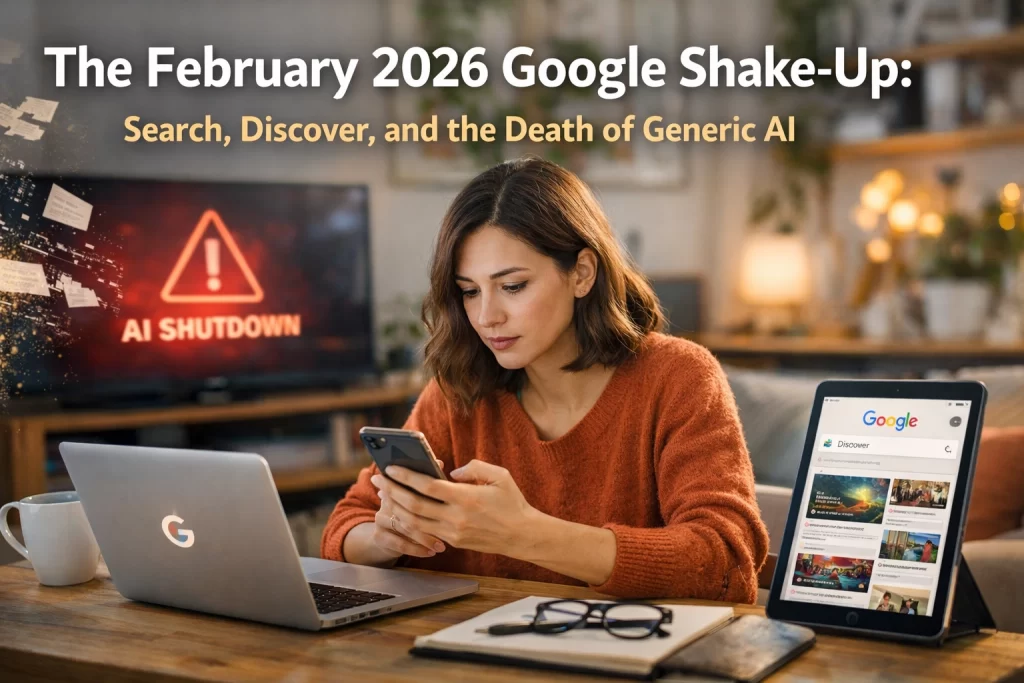
If you noticed your traffic taking weird swings in early February, you're not imagining things. Google just dropped two massive algorithm updates at once, and for the first time ever, they're treating Search and Discover as completely separate ecosystems.
Translation? The rules just changed. What worked to rank in traditional search won't necessarily get you featured in people's Discover feeds anymore. And if you've been relying on generic AI content to flood the internet with "SEO-optimized" fluff, you're about to have a really bad time.
Let's break down what actually happened, what it means for your business, and how to stay visible when everyone else is scrambling.
The Great Splinter: Why Search and Discover Just Filed for Divorce
Here's the headline: Google officially split Search and Discover into two different ranking systems. On February 5, 2026, they rolled out a dedicated Discover Core Update alongside their regular February Core Update for traditional search results.
Why does this matter? Because your website could be crushing it in search rankings but completely invisible in Discover feeds, or vice versa. The algorithms now evaluate your content differently depending on where users find you.
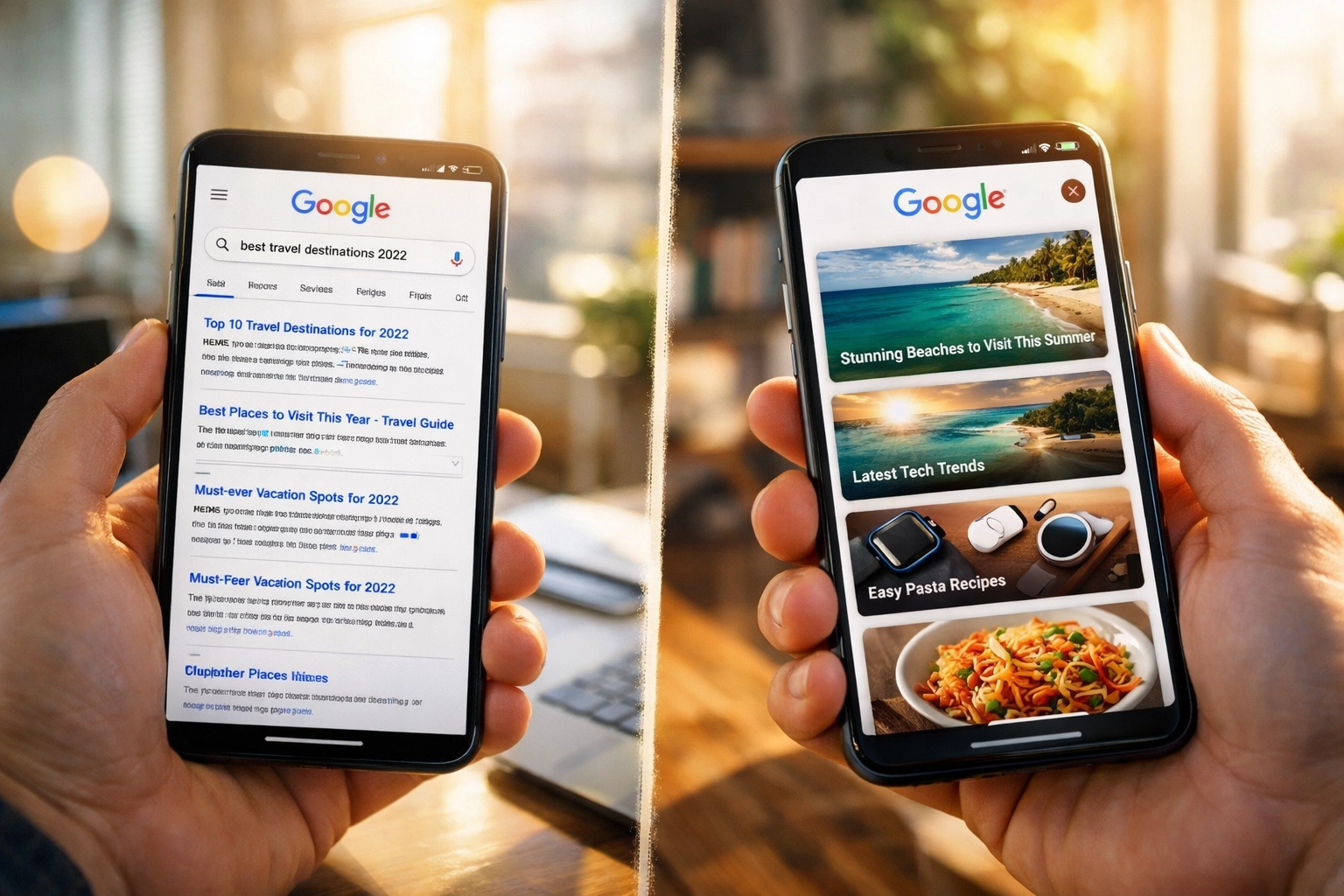
Think of it like this: Search is still about answering questions people are actively typing into Google. Discover is about serving content people didn't know they wanted, yet. It's proactive versus reactive. And Google is now optimizing each experience separately based on what actually works in those contexts.
What this means for you: You can't assume traffic from one channel guarantees traffic from the other. If you've been focusing exclusively on keyword rankings, you might be missing out on an entirely separate discovery pipeline. And if your content strategy only works for one channel, you're leaving half the table empty.
The AI Content Purge: Why "Batch and Blast" Just Died
Let's talk about the elephant in the room, AI-generated content. Google didn't ban it. They just made it painfully clear they're done rewarding low-effort, mass-produced garbage that reads like a robot wrote it in 30 seconds.
The February updates doubled down on E-E-A-T (Experience, Expertise, Authoritativeness, and Trustworthiness). But here's the kicker: they're now evaluating this topic-by-topic, not at the domain level. You can't coast on your site's overall authority anymore. Every piece of content has to prove its expertise on its own merit.
Google even gave an example: a local news site with a dedicated gardening section shows established expertise in gardening, even if they cover other topics. But a movie review site publishing one random gardening article? Not a chance.
What killed generic AI content:
- No depth. If your article could've been written by literally anyone with a ChatGPT prompt, Google sees through it.
- No experience. Algorithms can now detect whether a human with actual expertise touched the content or if it's just regurgitated information from ten other sites.
- No originality. Rehashing what's already out there won't cut it. Google wants fresh perspectives, case studies, and real-world applications.
The winning formula now? Human + AI collaboration. Use AI to speed up your process, sure. But you need a human expert to inject experience, nuance, and original insight. The content that ranks is the content that couldn't exist without someone who actually knows what they're talking about.

What Our CEO Says About the AI Shift
Peter Michaud, President and CEO of Twenty West Media, has been watching these changes closely:
"We've been telling our clients for months: quality always wins long-term. These updates just confirmed it. You can't shortcut expertise. The businesses that are going to thrive are the ones investing in real content from real people who know their stuff. Yes, AI is a tool, a powerful one, but it's not a replacement for human insight. If you're publishing content just to 'feed the algorithm,' you're already losing. Consistency and quality are the only strategies that survive every update."
That's the reality. Google isn't anti-AI. They're anti-lazy. And the gap between businesses that understand this and those that don't is about to get massive.
Local First, Clickbait Last: The Discover Update Explained
Now let's zoom in on the Discover Core Update specifically, because this one's a game-changer for how people stumble onto your business.
Google rolled out three major improvements to Discover feeds:
1. Local Relevance is King
Content from websites based in a user's country and aligned with their language and regional interests now gets priority. If you're a local business serving a specific area, this is huge. Generic, global content without clear regional relevance is getting buried under locally focused pieces.
Action step: Make sure your content speaks directly to your local audience. Regional case studies, local events, community stories, this stuff matters now more than ever.
2. Clickbait is Dead (Finally)
Google is explicitly de-prioritizing headlines that exaggerate, create artificial curiosity, or promise outcomes the article doesn't deliver. You know the ones: "This One Weird Trick Changed Everything!" or "You Won't Believe What Happened Next!"
Informative, accurate, and expectation-aligned headlines backed by substantive content are what get rewarded now. If your headline overpromises and your content underdelivers, you're toast.

3. Depth and Expertise Trump Broad Authority
This ties back to the topic-level expertise point. Google doesn't care if you're a big-name publisher anymore. They care if you have deep, demonstrated expertise in the specific topic you're writing about.
Original, in-depth, timely content from sites with proven expertise in a niche will outrank surface-level articles from generalist sites every time. That's the new playbook.
Why this matters: Discover is where people find content they didn't search for. It's impulse discovery. And Google is betting that users want locally relevant, authentic, expert-driven content, not sensational clickbait designed to game the system.
How to Win in This New Reality
Alright, enough doom and gloom. Here's what you actually need to do to stay visible and keep growing your business:
1. Audit your content for depth and expertise. Go through your site. Be honest. Which articles could've been written by anyone? Which ones showcase real experience and insight? Double down on the latter. Rewrite or delete the former.
2. Lean into local relevance. If you serve a specific geographic area, make that crystal clear in your content. Local stories, regional data, community involvement: these signals matter more than ever, especially in Discover.
3. Stop chasing clicks with sensational headlines. Write headlines that accurately reflect what's in the article. Promise what you can deliver. It might feel less "exciting," but it's what Google: and users: actually want.
4. Use AI as an assistant, not a replacement. Let AI handle research, outlines, and first drafts. But always have a human expert review, edit, and inject original insight before you publish. That human touch is what separates ranking content from invisible content.
5. Diversify your traffic sources. Don't put all your eggs in the Google basket. Invest in social media, email marketing, and direct relationships with your audience. Relying solely on organic search is riskier than ever.

6. Focus on topic-level authority. Pick your lane. Become the go-to resource for specific topics relevant to your business. Google is rewarding specialists, not generalists. You don't need to cover everything: you need to dominate your niche.
The Bottom Line
The February 2026 updates aren't just another algorithm tweak. They're a fundamental shift in how Google thinks about content quality, discovery, and expertise. The era of gaming the system with mass-produced AI content and clickbait headlines is over.
What wins now? Real expertise. Local relevance. Authentic storytelling. Human insight backed by AI efficiency.
If you've been cutting corners, this is your wake-up call. If you've been investing in quality, you're about to see that investment pay off big time.
The businesses that understand this shift: and adapt fast: will own the next chapter of organic visibility. Everyone else will wonder why their traffic disappeared.
Want help navigating these changes and building a content strategy that actually works? Let's talk. We've helped hundreds of businesses stay ahead of algorithm updates by focusing on what actually matters: quality, consistency, and real expertise.
The game changed. Are you ready to play by the new rules?